Are PlanToys Sustainable Wooden Toys Really Worth the Extra Cost?
-
A Box Label Says Sustainable Wooden Toys—and Your Shopping Cart Stops
-
Seven Graduates and a Tree: The Origin Behind the Label
-
From High Contrast to Montessori Corners: Tracing the Label Back to the Child
-
Green Story vs. Green Shelf: Two Comparisons That Assign the Extra Cost
-
Three Checks Before the Next Toy Box Arrives
One quiet Saturday morning finds you sorting the playroom into keep and donate piles. Your hand closes around a wooden stacking toy, and you flip it over: 'sustainable wooden toys,' it says. For a second, that sounds reassuring—then the doubt creeps in. Sustainable in what sense? Does it mean the wood came from a forest that was replanted, or that the paint is non-toxic, or that the company merely printed a green leaf on the box? The label gives you nothing. You look at the plastic music table your toddler has clearly outgrown, then at the wooden market basket she still carries around the house. If you're going to spend more on the wooden item, you deserve an answer beyond a marketing phrase. You need to know the material pathway, the waste strategy, and the link to a growing child. And you're not alone in that search. Every parent staring at a toy shelf wonders the same thing: is 'eco-friendly' just a price tag?
A Box Label Says Sustainable Wooden Toys—and Your Shopping Cart Stops
On a quiet Saturday morning, you're sorting the playroom into keep and donate piles. Your hand closes around a wooden stacking toy, and you flip it over: 'sustainable wooden toys,' it says. For a second, that sounds reassuring—then the doubt creeps in. Sustainable in what sense? Does it mean the wood came from a forest that was replanted, or that the paint is non-toxic, or that the company merely printed a green leaf on the box? The label gives you nothing. You look at the plastic music table your toddler has clearly outgrown, then at the wooden market basket she still carries around the house. If you're going to spend more on the wooden item, you deserve an answer beyond a marketing phrase. You need to know the material pathway, the waste strategy, and the link to a growing child. And you're not alone in that search. Every parent who has stared at a toy shelf wonders the same thing: is 'eco-friendly' just a price tag?
The doubt slides in easily. Read 'sustainable wooden toys' as a marketing phrase, and the suspicion writes itself. Visit PlanToys' homepage and you'll see the environmental promise sitting right next to 'Spring Favorites under $25' and a bold announcement for a Montessori-inspired collection. That juxtaposition can feel like proof that 'green' is just another sales pitch. But skepticism should open questions, not close them. The label alone doesn't tell you whether the factory recycles sawdust, whether the design considers age milestones, or whether any independent jury has handled the toys. If you stop at 'it's marketing,' you'll never know what's actually behind the wood. The smarter move is to ask three questions: What happens to production waste? What developmental need does the toy address? Who outside the company has evaluated it? A brand that answers all three is not the same as one that prints a leaf. And a brand that can't? That silence tells you more than any slogan.
Seven Graduates and a Tree: The Origin Behind the Label
PlanToys didn't start on a retail shelf; it started with seven university graduates in Thailand in 1981, united by a mission to spread optimism and creativity. Vitool Viraponsavan, one of the strongest voices in that group, went on to found PlanToys and guide its growth from a small workshop into a company serving Asia, America, Europe, and Australia. What makes this origin more than a neat founding story is the first product: the Geometric Sorting Board. It was launched during the company's first business year and is still sold today. If the founders had been chasing a quick return, that wooden toy would have been retired decades ago. Instead, it stayed in the catalogue, a quiet signal that families kept buying it because the toy met a real developmental need. That durable track record gave the young company credibility long before it talked about sustainability, and it set a precedent: PlanToys would measure itself by products that age well, not seasons.
The phrase 'Sustainable Way' appears throughout PlanToys' official materials, but it isn't a decorative slogan. The company describes it as three interrelated pillars: sustainable material, sustainable manufacturing, and sustainable mindset. That triad transforms a vague ideal into a checklist a purchaser can use. Suppose a rival brand claims to sell 'sustainable wooden toys.' You can now ask what its material source is, how its factories manage waste and energy, and whether its employees treat sustainability as a daily operating principle rather than a box-ticking exercise. PlanToys' own pillars are accompanied by an explicit claim that it focuses on sustainable materials and manufacturing methods, with a mindset that infuses its business culture. In practice, that three-way structure means the sustainability label is not just an attribute of the wood; it's a commitment that should show up in product pages, factory descriptions, and long-term company behavior. For a buyer, knowing these three pillars exist gives you a framework to judge whether a company's green claim has depth or is only surface paint.
The most tangible of those pillars is PlanWood, and it's the one you can almost see in the grain. Many wooden-toy makers purchase clean wooden blanks and treat the sawdust from shaping as waste to be swept away. PlanToys, in contrast, says it collects that leftover sawdust and presses it into a new material called PlanWood. This isn't an incremental tweak; it signals a factory designed backwards from the question of waste. Instead of cutting down another tree for every new toy, the company recycles the byproduct of earlier cuts into stable parts. The official description even states that green business practices are 'our forte,' and the named process gives you something you can verify. When a company identifies its waste-to-material loop by name, it invites you to trace the journey from log to playroom. This traceability is rare in the toy aisle, where 'sustainable' often stops at a forest-certification sticker. PlanWood, in short, is the difference between saying 'we care about the environment' and showing a closed material loop that you can see in the product itself.
From High Contrast to Montessori Corners: Tracing the Label Back to the Child
Sustainability alone wouldn't earn a place in your home if the toy failed to engage your child. PlanToys officially states that child development and sustainability are its top priorities. The company's design and production process centers on child safety and age milestones, aiming to enhance both physical and cognitive development. Look at a high-contrast toy in the baby collection: it's not just a pattern of black and white, it's meant to stimulate still-developing optic nerves and help a newborn begin to differentiate shapes. Move to a preschool sorting board, and you'll see a design that asks a child to compare, grasp, turn, and fit pieces—actions that build fine-motor control and early logic. These products are not random shapes; each is deliberately connected to a milestone. For a buyer, that's a powerful filter. If a brand cannot tell you which milestone its 'educational' toy serves, you are probably paying for a label, not for learning. PlanToys' focus on child development also extends to its environmental mission: the company intends that play with natural materials helps children grow closer to nature and internalize a green lifestyle, not just practice skills. And the iconic Geometric Sorting Board, in production since 1981, demonstrates that a well-designed, developmentally correct toy can endure across generations—a quiet proof that good design and good ethics can coexist.
PlanToys gives this developmental focus a formal home in its collections. The company's own product pages highlight a 'Montessori-Inspired Collection' alongside Blocks & Construction and Learning & Education categories. This is not just shelf arrangement; it signals a philosophy aligned with Montessori principles, which respect a child's capacity for self-directed, hands-on learning. The range also invites you to shop by developmental domain, such as mathematics and literacy, making it easier to match a toy to your child's next challenge. A Montessori-aligned toy is also a time-saver for parents who follow that method, because its design—open-ended, grounded in real tasks—already matches the prepared environment at home. Independent recognition adds another layer of evidence. PlanToys cites awards including the Belgian Play for Change Awards, the German Red Dot Design Award, and the Japanese Good Toy Award. These honors come from juries that evaluate toys against criteria like design quality and play value. A Red Dot, for instance, is not an eco-certificate; it's a design award, meaning the jury looked at how the toy feels, functions, and appeals to a child. When you see a toy's specific award cited, you know an external reviewer studied that product, not just the company's mission statement. For a parent, that external check helps justify the premium: you're not paying only for good intentions, you're paying for a design that experts have already scrutinized.
Green Story vs. Green Shelf: Two Comparisons That Assign the Extra Cost
When you compare PlanToys with other wooden brands, the first practical difference is catalog breadth. PlanToys' range starts with a High Contrast Series designed for early visual discovery, moves to farm-stand pretend-play baskets, and continues to blocks and construction sets that encourage problem-solving. The website also shows a PlanSpace modular dollhouse meant to grow with a child's storytelling, plus a Spinning Gears set that rewards fine-motor control. You can also find themed collections for fruit-and-vegetable play, a kaleidoscope, cooking utensils, and a sailing boat. This breadth matters because child development doesn't happen in one category. A single set of blocks might be called 'educational,' but a range that follows a child from high-contrast infancy through symbolic play and early mathematics offers more chances for genuine benefit. You don't have to buy the whole arc today; you have to confirm that the brand's design logic stays coherent when your child moves to the next stage.
Beyond range, look at how a specific toy stands up to design scrutiny. PlanToys' own citations describe the Ramp Racer as sturdy yet elegantly designed, with a visual contrast between wooden track and coloured racing cars that helps children follow the action. That sounds like more than tasteful wording; it connects design to a real developmental function—tracking fast-moving objects. Similarly, the Jumping Acrobat is described as child-friendly and reduced to essentials, which suggests designers considered little hands before deciding on embellishments. The company pairs these product-level details with a broader promise: 'Play Safe, Play Smart.' For your three-check process, that means examining whether a toy that interests your child has been recognized by an independent design jury. The Red Dot Design Award, which appears in PlanToys' official list, is one such marker. It tells you that a reviewer looked at that actual product and found its form and function worth praise. When a sustainable claim comes with this kind of design-level evidence, you are no longer buying on faith.
Three Checks Before the Next Toy Box Arrives
Now you can convert everything into a repeatable test. When you stand in front of the next wooden toy, run three checks. First, material loop: Does the company name what happens to production waste, as PlanToys does with PlanWood? If you only see the word 'wood,' put the box down. Second, development logic: Does the product page tie the toy to a specific skill or age milestone—visual tracking, hand-eye coordination, early math? Cute shapes aren't evidence. Arrows to an infant's visual cortex are better. Third, outside witness: Has this particular toy earned an award or expert review that explains what works? PlanToys leans on design awards like Red Dot and its 'Play Safe, Play Smart' framework, which gives the third check teeth. When all three pass, the premium evaporates as a charge and becomes a rational investment in verified design. When one fails, the sustainable story is weaker than the price suggests.
Back on the playroom floor, you flip the wooden stacking toy one more time. The words 'sustainable wooden toys' no longer read as a single promise; they read as three questions. Which leftover sawdust became this block? What skill does its shape invite? Who else has examined it closely? Run those questions against the next possibility, and buying stops being a gamble. You'll either find a product with a traceable material loop, a developmental purpose, and independent recognition—or you'll find a box that only looks green. That's the split your budget deserves. The label isn't the answer. It's just the opening line of a conversation you can now finish.
Back on the playroom floor, you turn the wooden stacking toy over one more time. The words 'sustainable wooden toys' no longer read as a single promise; they read as three questions. Which leftover sawdust became this block? What skill does its shape invite? Who else has examined it closely? Run those questions against the next possibility, and buying stops being a gamble. You'll either find a product with a traceable material loop, a developmental purpose, and independent recognition—or you'll find a box that only looks green. That's the split your budget deserves. The label never was the answer. It only opened a conversation you can now finish.
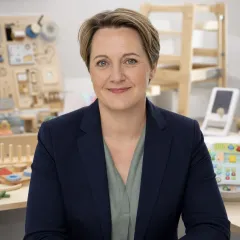
Miriam Adler
Miriam Adler is an educational and STEM toy analyst specializing in busy boards, Montessori-style manipulatives, learning towers, sound books, reading pens, pretend-play sets, and early learning toys. She applies ASTM F963 and IEC 62115 methods while evaluating small-part hazards, accessible edges, switch durability, sound output, battery access, pull force, and age-appropriate task complexity. Her work helps parents, retailers, and product teams choose learning products that align developmental goals, supervision needs, interaction design, and the intended age stage.